

Rebel Without a Cause was directed by Nicholas Ray and released in 1955, starring James Dean, Natalie Wood and Sal Mineo. The film has fairly gained a place among the lists of best films ever produced, and is still being praised for the directing of Nicholas Ray and the acting of the main actors, securing three Academy Award Nominations including Best Actor in a Supporting Role for Sal Mineo, and best actress in a Supporting Role for Natalie Wood. The film was ground-breaking for revolving around themes that dealt with the life of teenagers in — what was considered at that time — more ‘realistic’ manner. The film illustrates the struggles of teenagers during their school years: their agony to fit in, to discover their identity, and how to function according to the rules of society.
After the release of Rebel Without a Cause, gradually more films were released each following year which presented the life of teenagers, creating a new genre of films: the teen films, and coming-of-age films. A few examples of such films are West Side Story (1961) by Jerome Robbins and Robert Wise, The Graduate (1967) by Mike Nichols, American Graffiti (1973) by George Lucas, and Ferris Bueller’s Day Off (1986) by John Hughes. Rebel Without a Cause was also the first film that dared to reveal the wild and aggressive side of teenagers, stepping away from the embellished, conventional, and forged conservative depiction of teenagers which up until that point in time was dominant in cinema.
The film was a box office success, partly due to the premature death of James Dean less than a month before the film’s release, securing the film’s popularity. However, at the time, the film was met with mixed reviews by critics. Only a few critics praised the directing of Ray and the young actors’ performances, with Dean being praised for his ‘raw talent’ that shined throughout the film (Carter, 2008). While other critics, such as Bosley Crowther (1955), characterised the film as ‘violent, brutal and disturbing’, and as an unreasonably graphic portrayal of teenagers and their ‘weird ways’. Despite mixed -and often negative- reviews, the character of Jim Stark (played by Dean) with his iconic red jacket became an immortal symbol of the rebellious nature of teenagers against their parents. Teenagers felt that their issues were finally addressed, and found a hero in the image of Jim Stark.
Social Norms and the Model American Family
For decades, in Hollywood, the modern American family was being portrayed as a model family worthy of admiration; a type of family that was shaped by social conventions. A model family is primarily characterised by stability and discipline, emphasising their religious faith, especially Christianity, which becomes a source of order and ethos, as well as enhances the family’s sense of honesty and fairness. In Hollywood, it was not attractive to show real family issues and conflicts, but instead depict a family that would be an example to real families. Certainly family issues have been shown before, such as adultery, widowhood, and divorce, but they were explored merely as components to the plot and not as moral, realistic issues, such as in film noir. By the mid- to late 1950s, family issues became key themes to spark dilemma in melodramas as seen in the films of Douglas Sirk.
In Rebel Without a Cause, the model family is exposed as a facade and immediately collapses, revealing that its content is rotten and decayed. In the film, it is evoked that the need to maintain this depiction of the model family, creates a notion of repression and control, since all family members would have to succumb to this perfect image of the model family, suppressing their issues, conflicts, and concerns. Rebel Without a Cause showcases the stories of three teenagers who come from dysfunctional families, with each family facing different issues, destroying the idea of the model American family, but also illustrating the societal pressure to ‘keep up with appearances’.
In several scenes of the film, we observe subtle moments in which social conventions dictate and interfere with the characters’ behaviour. For example, when Jim arrives at his new school, we see a crowded front yard filled with cheerful students chatting when suddenly a cannon fire is heard. Everybody stays quiet and still while the American flag is hoisted up. This scene shows a sensible and respectable act, but it’s inclusion seems purposeful. The act feels forced and obtrusive to the teenagers’ normal behaviour. The silence of their chatter is uncomfortable and unnatural. In same scene, we are shown students entering the school through the building’s main entrance, and avoiding stepping on the school insignia which is engraved on the ground. Jim does not notice the insignia, as it is his first day in school, and steps on it by mistake . Another student immediately reacts upon seeing this, and tells Jim that he is being disrespectful. Jim apologises with sincerity and the other student realises how abruptly he acted, and he eventually helps Jim to find his classroom. This incident acts like a metaphor: the school milieu is considered to be the ‘first’ society a person comes across, with this ‘society’ testing the functionality and social conformity of the individual. If the individual conforms to the rules, then they are accepted into and by society. In this case, stepping on the school insignia represents rebellious behaviour which rejects social conventions, and thus — as society dictates — it is frowned upon and should immediately be confronted, like the student does with Jim.
Considering the film under a historical framework, another point that needs to be raised is the ‘atomic age’, which is directly referenced in the film: while Judy is having dinner with her family, her little brother is playing with a toy gun and shouts out loud ‘the atomic age’. After the fall of the atomic bombs in Hiroshima and Nagasaki in 1945, the entire world became horrified and even paranoid of the destructive abilities of atomic technology. In schools, children were taught about the nuclear bomb through documentaries, and even practice drills in case of nuclear destruction. The children born after the end of the Second World War were raised under the ‘shadow of the mushroom cloud’; they were raised in fear and uncertainty, constantly facing an existential threat. The atomic age which is a period of instability, is antithetic to the solidity of at the typical American family. The teenagers’ attempts to cope with the existential threat of the atomic bomb might act as an extra motive for them to be aggressive and rebellious against their parents, and thus the society.
Searching for Honour: The Character of Jim Stark
The film looks at a day of the life of Jim Stark, a teenager living in the United States with his parents and grandmother in a middle-class family. In the opening shot, Jim is lying down on a street, next to a toy monkey, drunk (fig. 01). He gently grabs the toy and starts playing with it, and he eventually places the toy down on the street, covering it with a wrapping paper; like a mother does when she puts her child to sleep. Then, he crawls closer to the toy and lies in fetal position (the scene was improvised by Dean). The use of a close shot and eye-level angle brings the character to our level. His facial reactions and motions, and especially his posture at the end of the shot, highlight his innocence and childlike behaviour. From this opening shot, the film successfully introduces the personality of Jim: a teenager who is not ready to grow up.

Jim a child living in a family with a domineering mother, strict grandmother, and a submissive father. In the first scene of the film, Jim is taken to the police station for wandering the streets drunk. The scene demonstrates his anguish and suppressed anger against the overbearing female figures of his family, as well as his overwhelming disappointment with his father’s meek nature. In the scene, his parents are arguing while trying to understand what bothers their son, the tight framing and the position of his parents’ figures on the right and left of the frame emphasise Jim’s feelings of suffocation caused by his parents (fig. 02). In another scene, Jim discusses his moral dilemma to his parents: whether he should go to the police to testify about an accident that happened at this presence, and caused the life of one of the school bullies (fig. 03). His parents advise him to hide the truth and not testify to the police, but Jim feels that this action is not honourable. Jim asks his father to stand up with him against his mother and support his opinion, but his father is reluctant and hesitates to do so. In a desperate act of anger and disappointment, Jim physically attacks his father . At the end of the scene, he storms out of the house in tears, feeling lost and that once more he was not understood by his parents.


Jim is probably the most relatable character of the story as many teenagers, during their adolescence, realise their parents are not the kind of people they thought they were. They start seeing their parents’ weaknesses and faults and become disappointed. They become rebellious, believing that they should escape from their parents, and thus ultimately saving themselves from becoming like their parents when they grow up. In the case of Jim, he sees the weak nature of his father and considers it pathetic and miserable, losing his respect towards him. He cannot stand his mother since he believes that she had emasculated his father, and tries to somehow avenge him by rebelling against her (fig. 04). He feels that the autarchic nature of his mother is an obstacle in their attempts of communicating with each other as a family, and he feels lost since he cannot talk to his parents for advice and guidance. Jim feels angry, trapped, and lonely since he cannot communicate with his family and has no friends as they just moved in to a new town.
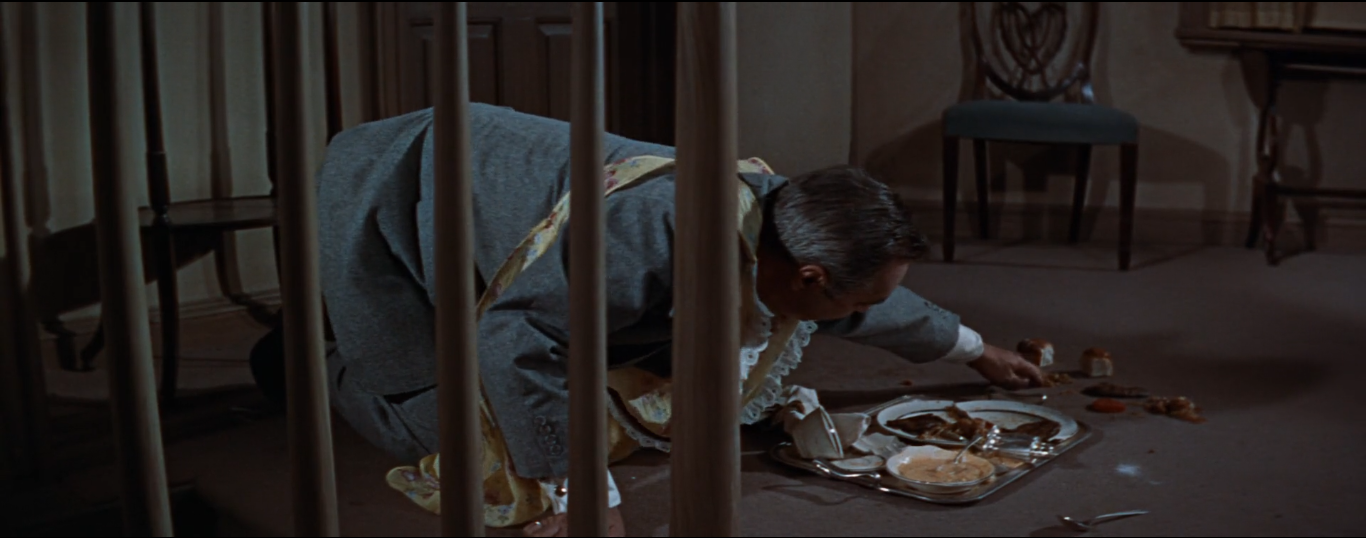
There are a few points to raise here. Despite the claims of Jim that his father is weak, we do not see his father actually being a weak character or being suppressed by his wife. The couple seems to have a good relationship; they certainly argue, but that does not mean that their relationship is dysfunctional. The supposed weakness of the father as seen by Jim is only Jim’s perception of his father, and if we evaluate his position by today’s standards, we come to the conclusion that it is quite toxic. His perception of the definition of man is reeked with toxic masculinity. Wearing a kitchen apron and tending to your wife does not mean that the character is weak. This is not how a man is defined. During their conflict, Jim’s father does not ‘stand up’ for his son. He does not stand up for Jim not because he is weak or scared of his wife, but because he agrees with her, and this brings us to another point of discussion.
Rebel Without a Cause is a kind of film that ‘changes’ depending on what age you watch it. The first time I have watched it, I was a teenager, and the second time I was an adult finishing up my MA on film production. The film seemed completely different on the second watch. It seemed that the film is not only addressing the problems of misunderstood teenagers, but also the issues of parents. When I watched Rebel Without a Cause as a teenager, I related with the teenagers of the film, and especially with the character of Jim. The angry and the rebellious nature of the character illustrated all confused teenagers. The performance felt realistic, and the conversations with his parents, and specifically with his father, bear all the appropriate attitude and reactions of a real dysfunctional family. Jim’s insecurities, agony, and feelings of entrapment make the character more human, adding more realism to his performance. Consequently, when a teenager watches the film, they feel understood and retaliated.
However, watching the film as an adult, I saw something different. The difference lies in one of the strongest scenes of the film; the scene in which Jim asks his father some advice on the issue of one’s honour. Jim was not sure if he should show up to the “chickie” run (two kids race in stolen cars towards the edge of a cliff, and whoever jumps first out of the car before it falls into the bottom of the cliff is a coward). In this scene, Jim’s father tries to tell Jim that this matter might look important to him now but when he grows up and looks back at it, he will realise that is a very insignificant problem. Jim tells his father that he cannot understand him, and feeling completely lost and unguided asks his father to give him a straight answer about what he should do. His father tries to reason with him and decides to make a list of the pros and cons of the matter, but Jim, being impatient and disappointed, storms out of the house because his father never gave him a straight answer. This is a key scene that reflects the different perspectives held by parents and their children.
The first time I watched the film I shared Jim’s view. I thought that his father was not strong enough to help him, and he was incapable of giving him answers, ignoring the importance of the matter. However, when I rewatched the film as an adult, I shared his father’s perspective. Children are taught to be honourable: stand up for the weak man, always tell the truth, confess your lies. But as one grows up, realises that this is only a façade. Often, there is neither honour in society, nor among people. People act according to what it is best for them; they do what they have to do in order to be safe, gain money, or keep their position in the world. Honour in the world becomes a utopian concept. This is something that an individual learns as they grow up, and this is the lesson of Jim. This is the reason why Jim’s father agrees with his wife and does not ‘stand up’ for his son, because life is complicated; life is not black or white, it is grey. Jim is morally right in his inclination to go to the police, but his parents are rightfully being protective and hesitant since this could affect his life. When Jim’s father claims that the ‘chickie run’ is an insignificant issue, he is right because he knows that in later life there will be other more important times when we will have to stand up to ‘bullies’; we have to stand up when it matters because there could be consequences. By the end of the film, we see a different Jim. He sees the consequences of his and his friends’ not so well-thought-out actions: the death of his friend Plato.

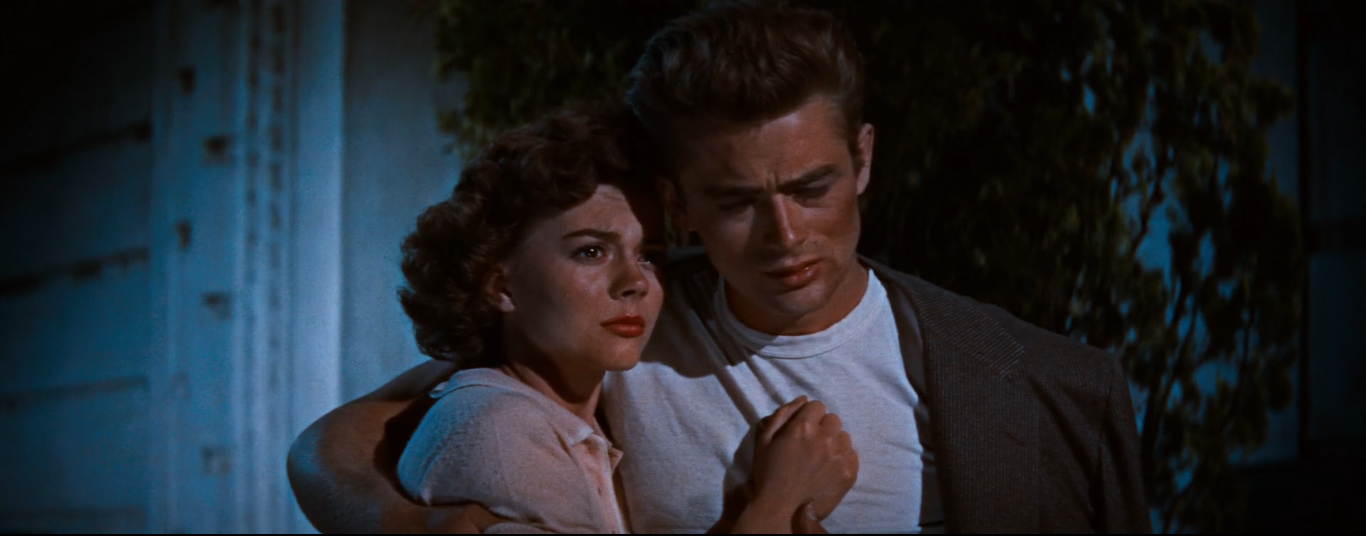
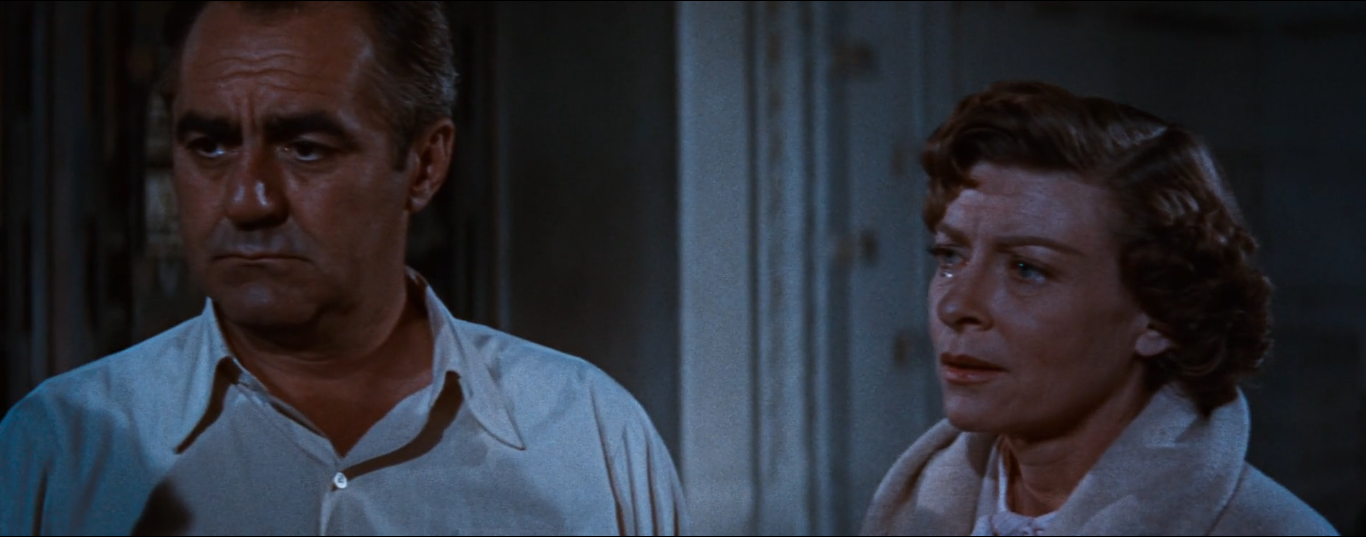
Plato’s death made Jim realise how difficult it is to raise a child. In that moment, he is ready to enter the world of adults since he has grown and has come to understand his parents’ perspective. He introduces Judy to his parents and they accept her with a warm smile (fig. 06). In these shots the couples are equal, with the similarities between being strong; they are dressed similarly and Judy’s hairstyle is the same as Jim’s mother (fig. 07). This is a reflection (fig. 06), an opposite image of the first shot of Jim (fig. 01): the child has finally become an adult. During the last shots, we see Jim’s father promising that he will be a stronger and supportive father, and helps his son stand up. This means that he had also learned something from his son; he reevaluates his priorities and sees what is important to Jim, and how he can be a better father to him.
Becoming a Wife: The Character of Judy
We first encounter Judy in the same police station where Jim was taken at the beginning of the film. Judy explains to the police officer that her father was angry with her, and had violently tried to smear off her lipstick since he considered it inappropriate for her young age (fig. 08). Judy complains that her father does not treat her like he used to. He became less affectionate and distant because of her growing up and entering into womanhood. Her father does not feel comfortable with his daughter’s sexuality, and does not know how to treat her properly, resulting in having arguments with her.

This is an unusual theme for the 1950s as female sexuality was not so broadly explored in Hollywood then. In film noir, the woman was seen as the femme fatale; the woman as an object of desire or trophy, or the woman who uses her sexuality to deceive men. The realistic portrayal of teenagers’ or women’s sexuality and sexual urges was a taboo subject until the 1960s. An example is Elia Kazan’s Splendor in the Grass (1961) which was about a teenage couple struggling with the urge and dilemma whether they should have sexual relations or not. Even though Judy might have been considered as ground-breaking in the 1950s, nowadays might be regarded as anti-feminist in the sense that her acts and motivations throughout the film seem very man-oriented. One may argue that this derives from the rejection she feels from her father. In one scene, Judy asks from her father to be affectionate and treat her like he treats her much younger brother, but the scene ends in them having a loud quarrel, with her father slapping her when she tries to kiss him. After this scene, Judy leaves her home in tears. The rejection she gets by her father evolves into feelings of resentment, resulting in her wanting to rebel against her family. A form of rebellion — perhaps to impress young boys — is her participation in bullying Jim at school and taking part in a race with stolen cars. After the death of Buzz, who was the boyfriend of Judy and the leader of their gang of bullies, she becomes attached to Jim and sees a potential husband in him. Her sudden intense feelings of romance and affection towards Jim underline her desperate need of filling up the void inside her with another male figure, driven by her father’s rejection. The film, instead of focusing on her becoming a woman, we see her fulfill the woman’s role which was acceptable and preferable then; she is now fit to become someone’s wife.
Rebel Without a Cause was released over 60 years ago, but is still a cinematic masterpiece and has rightfully gained a place among the best films of all time. One has to admit that some aspects of the film have not aged so well, like Jim’s perception of his father which reeks of toxic masculinity, and Judy’s anti-feminist character. Nevertheless, the ideas and themes of the film are still relevant, such as the relationship between parents and children, and the issues parents face trying to raise their kids. In the end, after all is said and done, growing up is never easy, and it is a comfort when someone recognises that.
Reference List
Graydon Carter (2008). Vanity Fair’s Tales of Hollywood: Rebels, Reds, and Graduates and the Wild Stories Behind the Making of 13 Iconic Films. Penguin Books. pp. 71–72.
Bosley Crowther (October 27, 1955). “The Screen: Delinquency; ‘Rebel Without Cause’ Has Debut at Astor”. The New York Times.
 chk Ithaca Studio